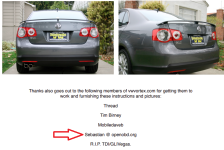
OK, at the risk of more scorn, I've just had several fingers of cheap Irish whiskey, and have some bottom-of-the-glass courage. So I reserve the right to edit this post in the morning.

First:
If the specific tails you're looking to install are not DOT approved, technically, it is.
I believe that's the second time you wrote to that effect, regarding the "illegality" of the Chinese-made taillights with amber turn signals I've got on the shelf in the basement.
I think that the term "DOT approved" is even worse than me saying " unlocking."
You know that DOT doesn't "approve" anything. DOT (through 108) merely establishes standards, among other things for lighting in the U.S.
And... The only lighting component that DOT (through 108)
requires be DOT-marked, to show that the manufacturer attests that they meet the standards, are headlights; they "shall" be DOT-marked. (So in that sense, of course, the Euro headlights on your Mk2 Rabbit, and on all the cars that we've owned, are/were technically illegal in the U.S. -- if anyone gave a sh!t).
No other lighting components are
required to be DOT-marked; taillights, for instance just "may" be DOT-marked. (I checked the reverse of the red-lensed taillights on my 2026 GLI, and they
are DOT-marked; unlike the Chinese ones.)
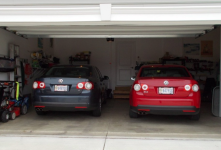
That still means that taillights need to meet the DOT/ requirements for color, visibility, reflectors, etc. (So the Euro LED taillights that I installed on our two Mk5's, with coding, were and still are illegal; since they didn't/don't have side reflectors). But, of course, unless you're in a state that does safety inspections, and if the inspector knows or cares, that doesn't matter.
So the fact that my Chinese-made amber-turn-signal Jetta taillights don't have DOT markings doesn't make them illegal. I'm confident they meet all the requirements.
Second... Someone (whom I've already apparently pissed off here enough) wrote that configuration modifications would be a violation of Type Approval.
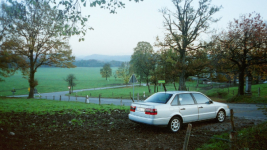
He was writing from Europe, where that would certainly be the case. Any configuration modifications there need to have specific legal type-approval certification; like from the TÜV in Germany. The slightly-lowered suspension I got for my U.S.-spec B4 Passat in Germany came with a TÜV certificate -- of course, under Status-of-Forces, I was exempt:
But as far as I understand, Type Approval here in the U.S. only applies to vehicles, as made and sold by the manufacturer. Any aftermarket modifications don't require any type approval or certification. The modifications would just have to satisfy the requirements of 108, responsibility of the owner. (And, maybe unfortunately, would only be caught in a really good inspection.)
Please understand that none of this is arguing that VAG would authorize SFD2 configuration changes. I'm just splitting hairs here, saying those may not be good arguments why they wouldn't...



 , what's a better one-word term than "unlocking"?




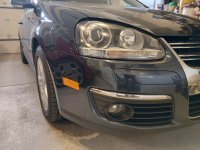

 wood screw to fasten it to the housing; because the plastic couldn't be cemented); and carefully heat and soften the back of the housing at one location on one headlight, to squish it in far enough to clear the radiator mount. Being very careful not to damage the reflector inside. And yes, I believe that was in lieu of taking a Dremel to the radiator mount... But it all worked well.
 Fortunately the front shapes of the headlights were identical...


 The world turns not around the US or the US's requirements and looking at how VW sales are going in the US due to all the market distractions, I would not be surprised if VW wasn't in a hurry to make things happen just for this market. But then again, let's be a little patient and not make this a political discussion or one about legal code vs. type approval. The reality is, nobody here can change the background to this when writing frustrated posts in a forum. If you want to approach this, there are certainly ways to do so, but none of them is easy at this point.